Commercial Pollinator Habitats: A Guide for Property Managers in the GTA
Executive Summary
Commercial properties are increasingly being asked to do more than simply provide attractive outdoor spaces. Today's office campuses, industrial parks, hotels, educational institutions, and mixed-use developments are expected to contribute to broader sustainability goals while creating environments that employees, tenants, customers, and visitors enjoy spending time in.
A professionally designed commercial pollinator habitat can help achieve those objectives.
By replacing underutilized turf grass and conventional ornamental plantings with carefully selected native plants, commercial properties can support biodiversity, create habitat for native pollinators, improve seasonal interest, and strengthen environmental stewardship initiatives—all while maintaining a polished, professional appearance.
This guide explains what commercial pollinator habitats are, why they matter, where they work best, and what property owners and managers should consider before beginning a project.

Quick Facts
Best suited for: Office campuses, industrial parks, hotels, healthcare facilities, schools, condominiums, municipal properties, and corporate headquarters.
Primary goal: Support native pollinators while enhancing the appearance and ecological performance of commercial landscapes.
Establishment period: Typically two to three growing seasons.
Long-term maintenance: Often lower than conventional turf landscapes once established.
Key benefits:
Supports biodiversity
Improves pollinator habitat
Reduces mowing requirements
Creates four-season visual interest
Strengthens sustainability initiatives
Enhances curb appeal
Demonstrates environmental leadership
Who This Guide Is For
This article is written specifically for:
Commercial property owners
Property managers
Facility managers
Commercial developers
Corporate sustainability professionals
Landscape architects
Condominium managers
Municipal staff responsible for public landscapes
Although many of the principles also apply to residential properties, this guide focuses on the unique opportunities and considerations associated with commercial landscapes.
Commercial Landscapes Are Changing
For decades, commercial landscaping followed a familiar formula.
Large expanses of turf grass, neatly clipped shrubs, and annual flower displays became the standard across office buildings, industrial parks, retail developments, and institutional properties throughout Southern Ontario.
These landscapes often looked attractive, but they were rarely designed to support local ecosystems.
Today, expectations are changing. Businesses are increasingly investing in landscapes that contribute to sustainability, biodiversity, employee wellbeing, and environmental stewardship. At the same time, property managers are looking for ways to reduce maintenance inputs while maintaining the professional appearance their tenants and visitors expect.
Commercial pollinator habitats address both objectives.
Rather than viewing landscaped areas as purely decorative, organizations are beginning to recognize them as opportunities to create living ecosystems that benefit both people and wildlife.
What Is a Commercial Pollinator Habitat?
A commercial pollinator habitat is an intentionally designed landscape that provides nectar, pollen, nesting opportunities, and shelter for native pollinating species while complementing the appearance and function of a commercial property.
Unlike unmanaged natural areas, commercial pollinator habitats are carefully planned. Plant selection, bloom timing, height, colour, seasonal interest, pedestrian circulation, maintenance requirements, and sightlines are all considered during the design process.
The result is a landscape that feels welcoming and refined while delivering measurable ecological benefits. Native bees, butterflies, hoverflies, hummingbirds, beneficial beetles, and many other species rely on flowering plants throughout the growing season. By providing those resources within urban and suburban environments, commercial properties can become important pieces of a much larger ecological network.
Even relatively modest habitat installations can contribute to biodiversity when thoughtfully designed.
Why Pollinator Habitats Matter
Pollinators are responsible for the reproduction of thousands of flowering plant species.Without them, many natural ecosystems would struggle to function.
Unfortunately, habitat loss remains one of the greatest challenges facing pollinator populations.
Urban development has replaced many native meadows, woodlands, and grasslands with buildings, roads, and traditional landscaping. While these landscapes often include greenery, they may offer limited food or nesting opportunities for native insects.
Commercial properties present a unique opportunity to help reverse this trend.
Office campuses, business parks, schools, healthcare facilities, and industrial sites often contain significant landscaped areas that can be redesigned to provide meaningful ecological value without compromising appearance or functionality.
Rather than serving as isolated islands, these habitats can help connect fragmented green spaces throughout the Greater Toronto Area, allowing pollinators to move between food sources as they forage.
More Than Beautiful Flowers
When people hear the phrase "pollinator garden," they often imagine colourful wildflowers buzzing with bees. While flowering plants are certainly important, a successful commercial pollinator habitat is much more than a collection of blooms.
Healthy habitats include a diverse community of native grasses, flowering perennials, shrubs, and occasionally trees.
Each plays a different role.
Native grasses provide nesting material, shelter, and winter structure.
Flowering plants supply nectar and pollen throughout the growing season.
Standing stems create nesting opportunities for solitary native bees.
Seed heads provide food for birds long after flowering has finished.
Together, these elements create resilient plant communities capable of supporting a wide range of wildlife while remaining visually appealing throughout the year.
Choosing the Right Location

One of the most common misconceptions is that creating pollinator habitat requires converting large portions of a property. In reality, successful projects often begin with relatively small, underutilized spaces.
Areas that provide little functional value but require frequent mowing can often be transformed into attractive habitat with minimal disruption to the property's daily operations.
Examples include:
Perimeter lawn areas.
Parking lot islands.
Entrance gardens.
Stormwater management areas.
Utility corridors.
Courtyards.
Building setbacks.
Difficult-to-maintain slopes.
The objective is not to eliminate every lawn.
Instead, it is to ensure that each landscaped area performs the function best suited to its location.
High-traffic recreation areas may remain turf.
Prominent entrances may feature formal native planting.
Larger peripheral spaces may transition into naturalistic meadow-style habitats.
This balanced approach allows commercial properties to improve biodiversity while maintaining flexibility and usability.

Designing Habitats That Look Professional

One concern many property managers share is whether native landscapes will appear untidy.
Professional pollinator habitats are designed very differently from unmanaged fields.
Successful commercial installations incorporate design elements that communicate intention and care.
Clean Edges
Defined borders immediately create a sense of order.
Steel edging, stone, concrete pathways, or regularly maintained mowing strips establish clear transitions between naturalistic planting and surrounding landscapes.
Layered Planting
Plants are arranged according to height, bloom period, texture, and visual composition.
Shorter species are positioned near pathways and entrances to maintain visibility, while taller grasses and flowering perennials create depth further into the planting.
Seasonal Structure
Commercial landscapes should remain attractive long after flowering has ended.
Warm-season grasses, persistent seed heads, and structural perennials continue to provide visual interest throughout autumn and winter while supporting wildlife.
This combination of ecological function and thoughtful design is one of the defining characteristics of successful commercial pollinator habitats.
Biodiversity Begins with Plant Diversity
The health of a pollinator habitat depends largely on the diversity of plants it contains.
A landscape dominated by one or two flowering species may provide impressive colour for a few weeks, but it cannot support pollinators throughout the growing season.
Instead, professional habitat design emphasizes bloom succession.
Early-flowering species support pollinators emerging in spring.
Summer-flowering plants provide abundant nectar during peak activity.
Late-season flowers help sustain pollinators preparing for winter or migration.
This continuous sequence of flowering plants creates a dependable food source while ensuring the landscape changes beautifully throughout the seasons.
For commercial properties, this also means the landscape remains visually engaging from April through October rather than peaking during only one part of the year.
Supporting More Than Pollinators
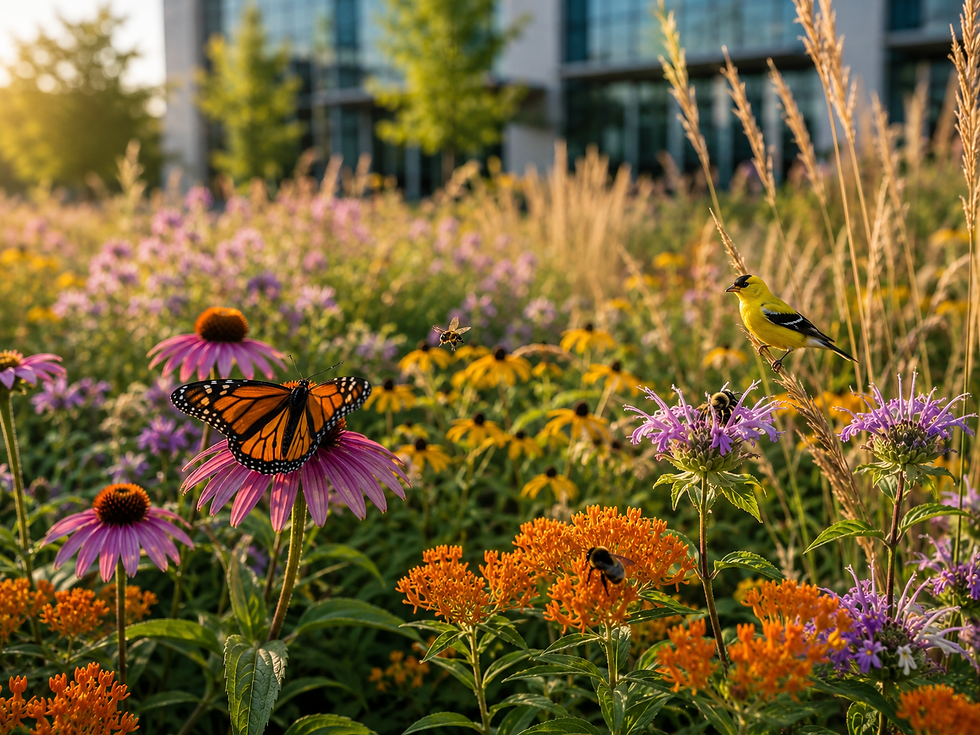
Although these landscapes are designed with pollinators in mind, their benefits extend well beyond bees and butterflies.
Native flowering plants support a wide variety of beneficial insects, many of which play important roles in healthy ecosystems. Those insects, in turn, become food sources for songbirds and other wildlife that increasingly struggle to find suitable habitat within urban environments.
The result is a landscape that functions as part of a larger ecological network rather than simply occupying space.
Employees may notice monarch butterflies drifting through the flowers during lunch breaks. Goldfinches may visit seed heads in late summer. Native bumble bees become regular visitors throughout the growing season.
These small experiences help reconnect people with nature in places where they spend much of their working day.
Pollinator Habitats and Corporate Sustainability
Many organizations now have environmental objectives that extend beyond energy efficiency and waste reduction.
Biodiversity has become an increasingly important component of corporate sustainability strategies, and commercial landscapes represent one of the most visible opportunities to demonstrate that commitment.
Unlike many sustainability initiatives that remain largely behind the scenes, pollinator habitats are experienced every day by employees, customers, tenants, and visitors.
They communicate environmental stewardship in a way that people can immediately see and appreciate.
Depending on the organization's priorities, commercial pollinator habitats may contribute to:
Biodiversity enhancement initiatives
ESG reporting objectives
Employee wellness programs
Community engagement
Educational opportunities
Climate resilience strategies
Urban greening initiatives
While every organization measures success differently, professionally designed landscapes often become one of the most recognizable environmental features on a property.
Maintenance Is Different—Not Eliminated
One of the most common misconceptions surrounding native landscapes is that they require no maintenance. The reality is more nuanced.
During the establishment period, native plantings require careful stewardship.
This typically includes:
Monitoring invasive species.
Selective weeding.
Supplemental watering during prolonged dry periods.
Assessing plant establishment.
Replacing unsuccessful species where necessary.
Once mature, maintenance generally shifts away from frequent mowing and toward seasonal ecological management.
Instead of mowing every week, the focus becomes annual cutbacks, invasive species monitoring, periodic inspections, and adaptive management as the planting evolves.
Many property managers find this transition appealing because maintenance becomes more strategic rather than repetitive.
Planning Considerations Before Installation
Every commercial property presents unique opportunities and constraints.
Before beginning a project, it is helpful to evaluate several practical considerations.
Site Conditions
Which lawn areas receive little pedestrian use?
Are there existing drainage issues?
How much sunlight does the proposed habitat receive?
Are underground utilities present?
Will snow storage affect plant survival?
Operational Considerations
How will maintenance access be provided?
Does the habitat affect visibility near roadways or entrances?
Are there irrigation systems that require modification?
What budget is available for establishment?
Organizational Goals
Is the project intended to support biodiversity?
Will it contribute to ESG objectives?
Is employee engagement part of the vision?
Would educational signage add value?
Should bee hotels or other habitat features be included?
Answering these questions before design begins leads to more successful long-term outcomes.
Bioterra Insight
One of the most effective commercial pollinator habitats isn't always the largest one.
Some of the most successful projects begin with a single entrance garden, parking lot island, or underused lawn strip.
These highly visible locations allow organizations to demonstrate environmental leadership while gaining experience maintaining native landscapes.
Once stakeholders see the results, future phases often become much easier to support.
In our experience, phased implementation frequently delivers better long-term outcomes than attempting to transform an entire property at once.
From the Field
One pattern appears repeatedly on commercial properties throughout Southern Ontario.
Large lawn areas are maintained because they have always been maintained—not because they provide meaningful value.
In many cases, only a small percentage of those spaces are regularly used by employees or visitors.
By carefully identifying underutilized areas, organizations can introduce pollinator habitat without reducing functional green space.
The result is a landscape that works harder—supporting biodiversity while maintaining the professional appearance expected of commercial properties.
Property Manager Checklist
Before planning a commercial pollinator habitat, ask yourself:
Site Assessment
☐ Which landscaped areas receive the least use?
☐ Where will habitat create the greatest visual impact?
☐ Are there opportunities to improve stormwater management?
☐ Will winter snow storage affect the planting?
☐ Have underground utilities been identified?
Maintenance
☐ Is there a plan for establishment during Years 1–2?
☐ Who will monitor invasive species?
☐ Has long-term stewardship been considered?
Biodiversity
☐ Does the planting provide blooms from spring through autumn?
☐ Are native Ontario species being prioritized?
☐ Will habitat features such as bee hotels be incorporated where appropriate?
Communication
☐ Will interpretive signage help explain the landscape?
☐ Does the project support sustainability or ESG goals?
☐ Can employees participate through educational initiatives?
Frequently Asked Questions
Do commercial pollinator habitats attract more stinging insects?
Pollinator habitats support a diverse range of beneficial insects. Most native bees are solitary and are generally non-aggressive when left undisturbed. Thoughtful design also considers the placement of habitats relative to building entrances and high-traffic pedestrian areas.
How long does a pollinator habitat take to establish?
Most native plantings begin showing significant growth during the first year and continue developing over the next two to three growing seasons before reaching maturity.
Are pollinator habitats suitable for small commercial properties?
Yes. Even relatively small planting areas can contribute to biodiversity while enhancing the appearance of the property.
Will maintenance costs decrease?
Maintenance often changes rather than disappears. Over time, many organizations experience reduced mowing requirements, although ecological stewardship remains an important part of long-term management.
Can pollinator habitats improve employee wellbeing?
Naturalized landscapes can create more attractive outdoor spaces for employees and visitors, encouraging people to spend time outside and experience seasonal changes within the landscape.
How do pollinator habitats support ESG initiatives?
Pollinator habitats can demonstrate measurable action toward biodiversity enhancement and environmental stewardship while supporting broader corporate sustainability objectives.
Related Services
Bioterra Habitats offers:
Commercial Native Landscape Design
Pollinator Habitat Installation
Lawn-to-Meadow Conversions
Native Bee Hotels
Biodiversity Consultation
Living Green Walls

Conclusion
Commercial landscapes have the potential to be far more than decorative spaces.
With thoughtful planning and the right plant selection, they can become living ecosystems that support biodiversity, strengthen sustainability initiatives, and create memorable outdoor environments for the people who use them every day.
The most successful pollinator habitats do not attempt to replace every lawn or imitate unmanaged natural areas. Instead, they identify opportunities where ecological function and professional landscape design can work together.
For property owners and managers, that means creating landscapes that are attractive, practical, resilient, and environmentally meaningful.
As businesses continue investing in sustainability and environmental leadership, commercial pollinator habitats are likely to become an increasingly important component of modern landscape design across the Greater Toronto Area.
Ready to Explore Pollinator Habitat on Your Property?
Every commercial property has opportunities to support biodiversity.
Whether you're considering a small demonstration garden or a phased transformation of larger lawn areas, Bioterra Habitats can help identify practical, site-specific solutions that align with your operational needs, maintenance objectives, and sustainability goals.
Contact Bioterra Habitats to schedule a consultation and discover how your landscape can become a valuable part of Southern Ontario's growing network of pollinator habitats.


